

Verdict · Series 01 · Oakley Prizm
Prizm Trail vs Prizm Trail Torch
Oakley discontinued Prizm Trail and points its buyers at Trail Torch. On paper they are one point apart, 36% against 35% stated transmission. On our bench they are not close: under one locked exposure Trail passed 55.1% of the light of our clear control and Trail Torch passed 43.2%. That is the widest gap between spec sheet and measurement in the whole Prizm set, and it changes what "replacement" means if you own the old lens.
01
The verdict
They are different lenses, not a rename. In the same light, at the same camera settings, Trail Torch passes roughly a fifth less light than Trail (43.2% against 55.1% of the clear control, a 11.9 point gap on a stated difference of one point). Trail is also far more saturated: a strong orange against Trail Torch's soft coral.
- Keep Trail if you ride dark forest. It holds more light and more punch under dense cover, which is exactly where a trail lens earns its keep. Supply only shrinks from here, so a good used one is worth having.
- Choose Trail Torch for mixed and brighter rides. It sits usefully between Trail and the road tints, and the calmer coral view is easier to live with when the trail opens up.
- Replacing a worn Trail with a Torch? Expect a noticeably dimmer, less saturated view. Not worse, but not the lens you had. This page exists so that is not a surprise.
02
The evidence
Both specimens photographed in one session on one stand against one wall, nothing changed between frames but the lens. Left Trail, right Trail Torch.
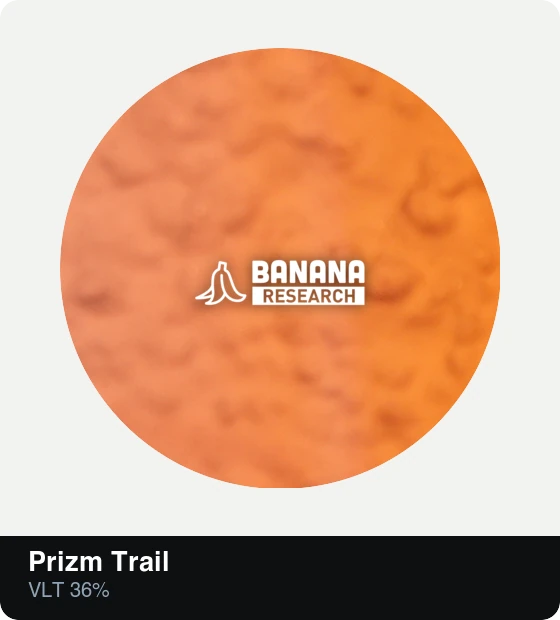
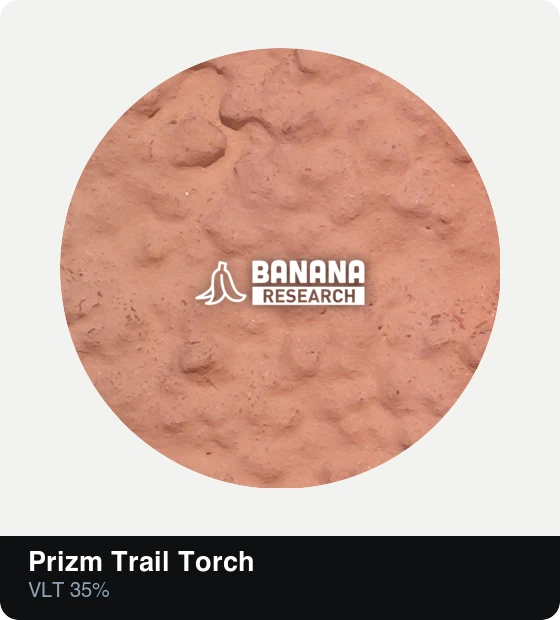
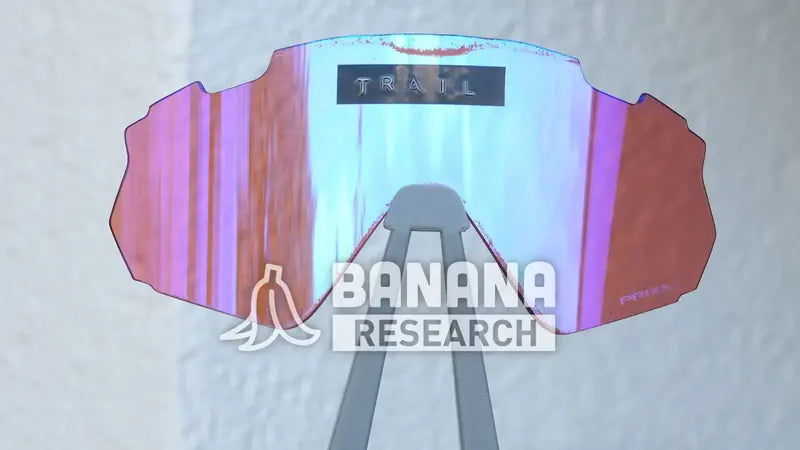
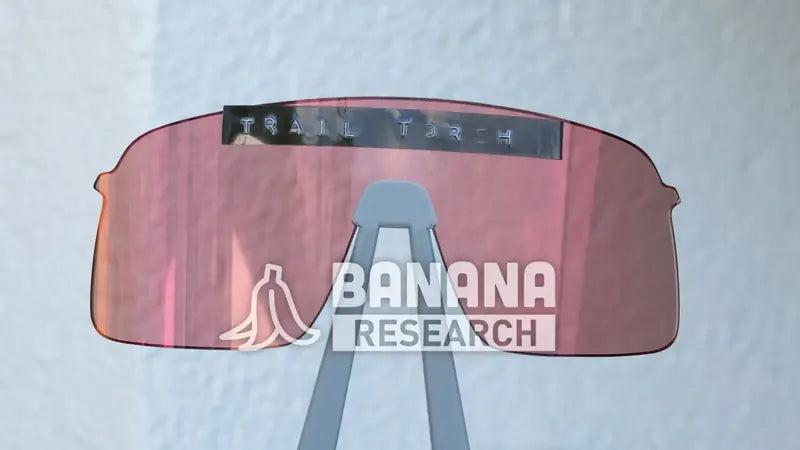
The sampled wall colour tells the same story as the full frames:
#ed8549 through
Trail against
#cf8d76 through
Trail Torch. One is an orange filter with real intent, the other is a warm tint.
03
The numbers
| Prizm Trail | Prizm Trail Torch | Prizm Road | |
|---|---|---|---|
| VLT stated | 36% 5 | 35% 4 | 20% 3 |
| Category | CAT 2 | CAT 2 | CAT 2 |
| Measured | 55.1% | 43.2% | 20.5% |
| Sampled colour | #ed8549 |
#cf8d76 |
#735359 |
| Look through | Strong saturated orange | Soft coral | Muted rose brown |
| Mirror | Blue violet iridium, red toward the edges | Orange | Violet |
| Status | discontinued | Current | Current |
Measured is this study: linear raw luminance through the lens as a percentage of the clear control, one session, one locked exposure. It is camera relative, not a lab VLT, and a camera sensor reads warm tints high. Both lenses here are warm, so the comparison between them is on fair ground; treat the absolute numbers with care and the gap between them with confidence.
04
What it means on the trail
The stated numbers say these lenses are twins. The bench says Trail Torch behaves like a noticeably darker lens with a calmer colour. In practice that moves it half a step toward the road tints: better mannered on open ground and bright days, less lift in the dark timber where Trail was at its best.
The saturation gap matters as much as the brightness gap. Trail's strong orange pushes contrast between browns and greens hard, which is what made it a cult lens for roots and loam. Trail Torch keeps the warmth but not the intensity. Riders who loved Trail for its effect will notice; riders who found Trail cartoonish will prefer the Torch.
05
And against Prizm Road?
The other question we get asked, and the one an earlier version of this article covered: Trail Torch against Prizm Road for mixed riding. The table above settles the light side of it. Road measured 20.5% against Trail Torch's 43.2%, so Torch passes roughly twice the light. Road is the sharper choice for open tarmac in full sun; Trail Torch is the one lens of the two you can carry into the woods without it going flat. Colour differs too: Road is a muted rose brown, Trail Torch a warm coral.
Every Prizm lens we bench tested, including these three side by side, is in the lens reference with the comparison preloaded.
06
Method in brief
All specimens were photographed in one session against one rendered wall on the same 3D printed stand, Sony ILCE-6700 with a Sigma 18-50mm f/2.8 DC DN, manual exposure locked at 1/500s · f/8 · ISO 100 · 50mm, white balance 5000K, set on a grey card. Transmission is read from the raw files, not the camera JPEG, as the mean of one circular sample of clean wall seen through each lens, identical radius for every specimen, normalised to a clear control. The full apparatus, protocol and caveats are in the lens reference.
07
References
- Oakley, Inc. (n.d.). Sutro replacement lenses: Prizm Trail [Product page]. Cited for a stated visible light transmission of 36% (Prizm Trail). Retrieved July 24, 2026, from https://www.oakley.com/en-us/product/W0OO9406R?variant=888392404978.
- Oakley, Inc. (n.d.). Sutro Lite Sweep replacement lens: Prizm Trail Torch [Product page]. Cited for a stated visible light transmission of 35% (Prizm Trail Torch). Retrieved July 24, 2026, from https://www.oakley.com/en-us/product/WAOO9465R?variant=888392552884.
- Oakley, Inc. (n.d.). Sutro replacement lenses: Prizm Road [Product page]. Cited for a stated visible light transmission of 20% (Prizm Road). Retrieved July 24, 2026, from https://www.oakley.com/en-us/product/W0OO9406R?variant=888392404930.
Both lenses accept our prescription insert.